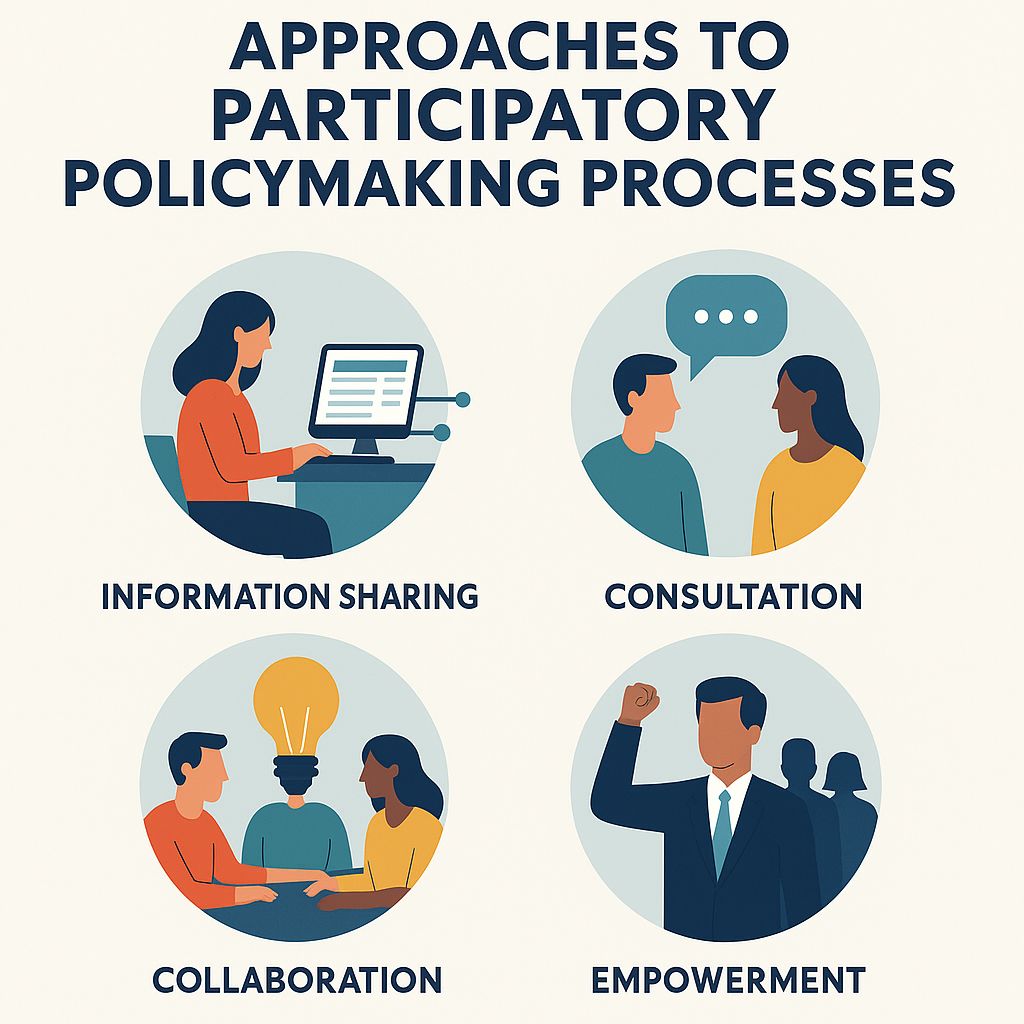
The project “Approaches to Participatory Policymaking Processes” was initiated by UNIDO, with support from the Government of the Republic of Korea, to better understand how multi-stakeholder participation can be systematically embedded into industrial policymaking and governance. It responds to a context in which governments are expected to deliver industrial upgrading, digital and green transitions, and resilience to crises, while facing complex trade-offs, diverse societal expectations, and rising demands for transparency and inclusion. The project recognizes that traditional top-down models of industrial policy are no longer sufficient on their own and seeks to clarify when, how, and under which conditions participatory governance can improve the quality, legitimacy and social acceptance of industrial strategies and projects.
To address this, the project combines a conceptual and practical exploration of participatory approaches. It reviews existing models of engagement – from traditional, expert-driven decision-making to socio-environmental co-management and newer systemic and innovation-oriented co-creation models – and links them to current debates on social acceptance, NIMBY dynamics, procedural justice and polycentric governance. Drawing on international experience, including examples such as electricity grid expansion dialogues in Europe, climate and energy model regions in Austria, energy strategy development in Jordan, and industrial and water strategies in Central Asia and Eastern Europe, the project distils how different forms and intensities of participation can shape outcomes. These insights are used to derive a structured four-step approach for organizing participatory processes: preparing the process (including stakeholder and context mapping), organizing it (formats, rules and safeguards), implementing it (from information to genuine citizen power), and evaluating results through systems-analysis tools and participatory modelling.
Building on this foundation, the project develops a practical toolkit for policymakers and practitioners who want to design and run participatory industrial policy processes in a more consistent, evidence-based way. It introduces an evaluation framework around engagement, transparency, benefits and environmental impacts; discusses how to use environmental and social impact assessments as vehicles for meaningful local participation; and highlights the enabling role of digital tools and testbeds for co-creation. The resulting guidance is intended to standardize knowledge, support comparison and learning across cases, and help users move beyond tokenistic consultation towards participatory processes that genuinely integrate local knowledge, improve decisions, foster mutual learning and enhance the long-term legitimacy and effectiveness of industrial policy.
Approaches to Participatory Policymaking Processes