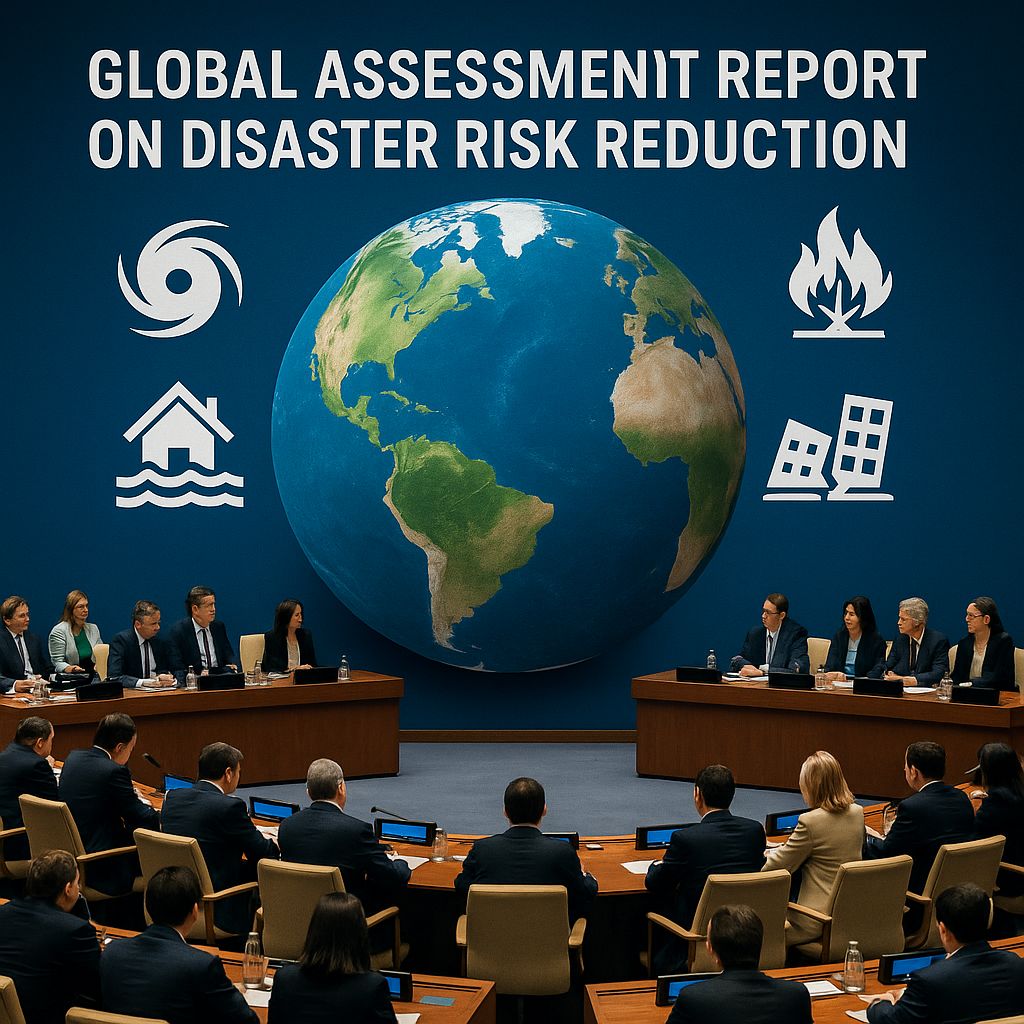
The Global Assessment Report on Disaster Risk Reduction is a flagship initiative of the United Nations Office for Disaster Risk Reduction (UNDRR) that examines how governance systems must evolve to confront a rapidly changing global risk landscape. Produced as the sixth edition of the GAR series, the project responds to intensifying climate impacts, the systemic shocks revealed by the COVID-19 pandemic, growing disaster losses, and persistent vulnerabilities linked to poverty, inequality and environmental degradation. Its central question is how to transform risk governance so that societies can manage systemic, cascading and transboundary risks while still advancing the Sendai Framework, the 2030 Agenda for Sustainable Development and the Paris Agreement.
To answer this, the project develops a conceptual and analytical framework that links disasters, hazards, exposure, vulnerability and systemic risk with human decision-making, data systems and governance arrangements. GAR is organized in three main parts: first, it diagnoses why disaster risk is increasing and how current development paths are pushing societies and ecosystems towards their limits; second, it explores how human cognitive biases, social norms and communication practices shape risk perception, investment and behaviour; third, it showcases emerging approaches in modelling, data, Earth observation and systems analysis that can support more anticipatory and integrated risk management. The report is built on contributions from a wide network of experts, case studies from all regions, and cross-cutting examples such as the systemic impacts of COVID-19 and risks in global food systems.
On this foundation, the project delivers GAR as both an assessment and a call to action. It argues that “business as usual” risk management is no longer sufficient and distils three core shifts needed to accelerate disaster risk reduction in an era of systemic risk: measuring what societies truly value (including ecosystems, equity and long-term resilience), designing systems that take into account how people actually make decisions about risk, and reconfiguring governance and financial architectures to work across silos and in genuine consultation with affected communities. By providing concepts, evidence, tools and practical pathways, the project aims to help governments, international organizations, the private sector and civil society embed systemic risk thinking into policy, planning and investment, thereby safeguarding sustainable development for present and future generations.
Global Assessment Report on Disaster Risk Reduction