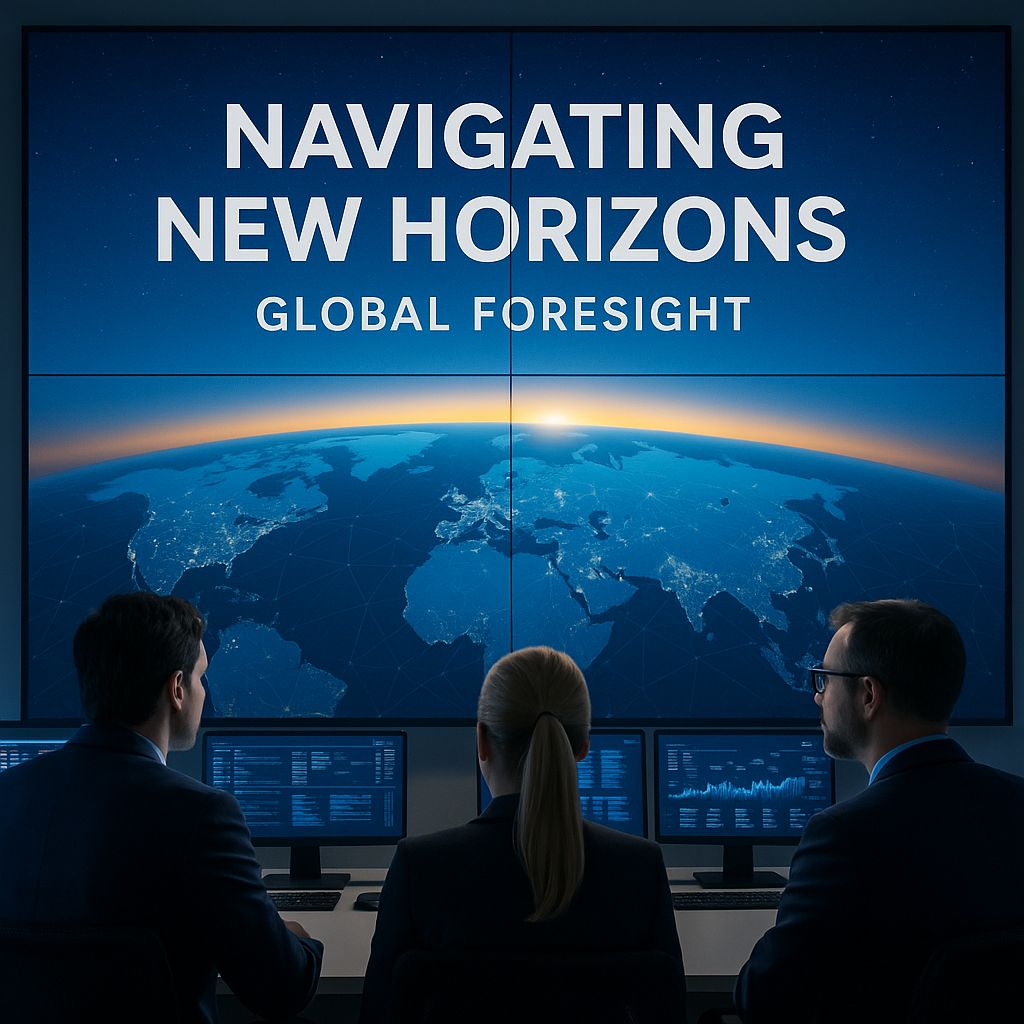
The Navigating New Horizons Global Foresight project, led jointly by UNEP and the International Science Council, was launched in 2023 to strengthen the UN system’s capacity to anticipate and prepare for future disruptions affecting planetary health and human wellbeing. It responds to a rapidly changing global context marked by the triple planetary crisis of climate change, biodiversity loss, and pollution, lagging progress on the SDGs, rising geopolitical tensions and the risk of a global “polycrisis” in which multiple crises become causally entangled. Against this backdrop, the project’s ambition was threefold: to build foresight skills, embed futures thinking into UNEP’s culture, and produce a forward-looking assessment that can guide more anticipatory decisions in the run-up to processes such as the UN Summit of the Future and the broader “UN 2.0” transformation agenda.
Over 18 months, the project implemented a multi-method foresight trajectory centred on global horizon scanning. It combined two rounds of Delphi surveys with almost 1,200 inputs from 790 respondents in the first round and 512 in the second, extensive qualitative analysis, and the work of an international Foresight Expert Panel of 22 scientists from diverse disciplines and regions. Issues raised in the surveys were clustered into 29 themes of emerging change and 280 “signals of change,” which were progressively distilled into a smaller set of signals with high disruptive potential. This analytical work was grounded and stress-tested through regional foresight workshops in all UNEP regions, youth sensemaking activities, and the development of four contrasting qualitative scenarios to 2050 that were used to challenge assumptions and explore how different futures might unfold in various contexts.
The resulting foresight product is both an assessment and a practical tool. The project identifies eight critical global shifts—including changing human–environment relations, resource scarcity, AI and digital transformation, new forms of conflict, mass displacement, widening inequalities, misinformation and polarization, and polycentric governance—as well as 18 priority signals of change that could significantly disrupt planetary health and human wellbeing if left unattended. It maps these shifts and signals against the SDGs and distils them into insights on where anticipatory action, agile and adaptive governance, improved monitoring and data systems, and a renewed social contract focused on wellbeing and intergenerational equity are most needed. Rather than predicting a single future, the project delivers a structured way for UNEP, other UN entities, governments and stakeholders to monitor emerging risks and opportunities and to use foresight systematically in strategic planning and policy design.
Navigating New Horizons Global Foresight project